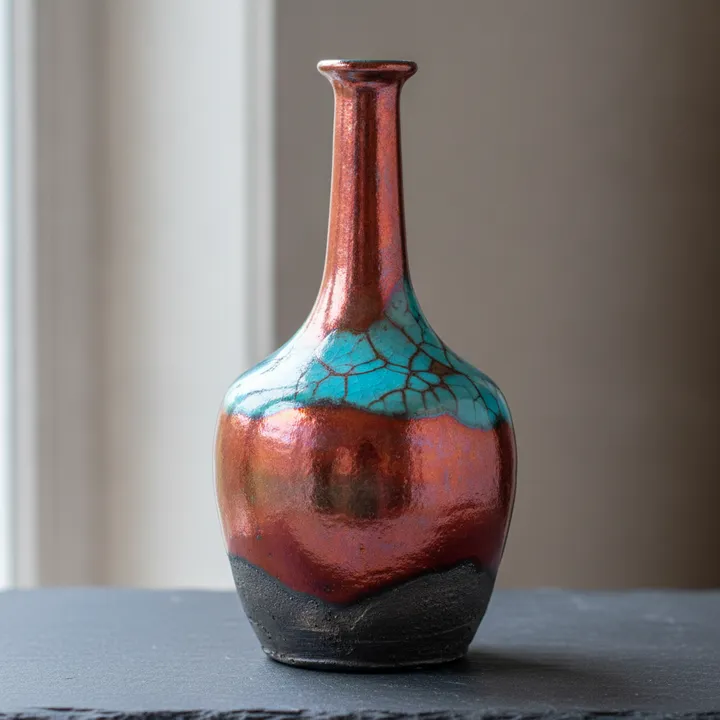
Raku glazeCopperIntermediate
Copper: turquoise or luster
Raku, about 950–1000 °C (1740–1830 °F)
One glaze, two results: strong reduction in a tight can gives copper red and metallic luster; if air gets in, or you open early, it goes to crackled turquoise. Every piece is different.
Version A · frit base
Base
| Ferro Frit 3134or an equivalent calcium-borate frit | 85 |
| EPK kaolinor any white kaolin | 15 |
| Total | 100 |
Additions, on top of the base
| Copper carbonate | 2.5 |
| Tin oxideoptional; helps the copper red | 1 |
Version B · Gerstley borate base
Base
| Gerstley borateor a Gerstley substitute; test a tile first, substitutes behave differently | 80 |
| Nepheline syenite | 20 |
| Total | 100 |
Additions, on top of the base
| Copper carbonate | 2.5 |
| Tin oxideoptional; helps the copper red | 1 |
Firing and reduction
For luster: a small can, little combustible, lid on within 15 seconds of ignition, and don't open before 15 minutes. For turquoise: let the piece cool longer in the air and reduce lightly, or open the can and let the flames lick it for a few seconds.
A formulated starting point. We have not fired it in our studio with these exact materials yet, so test it on a tile before a real piece.